Module 1 of 8 in Sell a digital product: the Sundayclear playbook
Find something worth building
One product idea, scored against profit, AI-buildability and platform ad-safety, so you pick it for reasons that hold up, not because you liked it first.
30 minutes Free
0 of 8 modules done
You have a list of ideas for a digital product and a strong pull toward the one that excites you most. That's the wrong first filter. Excitement doesn't survive contact with a platform's ad reviewer, a buyer's wallet, or the afternoon you spend actually trying to build the thing. Before you write a word of sales copy, you need a way to compare ideas that has nothing to do with how much you like them.
Outcome
By the end of this module you'll have scored three of your own product ideas against the same three axes Sundayclear used to pick its own, and picked one with reasons you can defend.
The idea
Score every idea on three axes, not one. Most people only check the first:
- Profit. Is there real demand and room for margin — a market that already spends money on adjacent things, not a market you're hoping to create.
- AI-buildable. Can the actual deliverable — the workflows, the templates, the copy, the walkthrough scripts — be produced mostly by an AI model, at a quality a buyer would pay for, without a studio or a team.
- Ad-safe. Will the honest description of this product survive a platform's ad policy, at the volume you'd need to actually reach buyers.
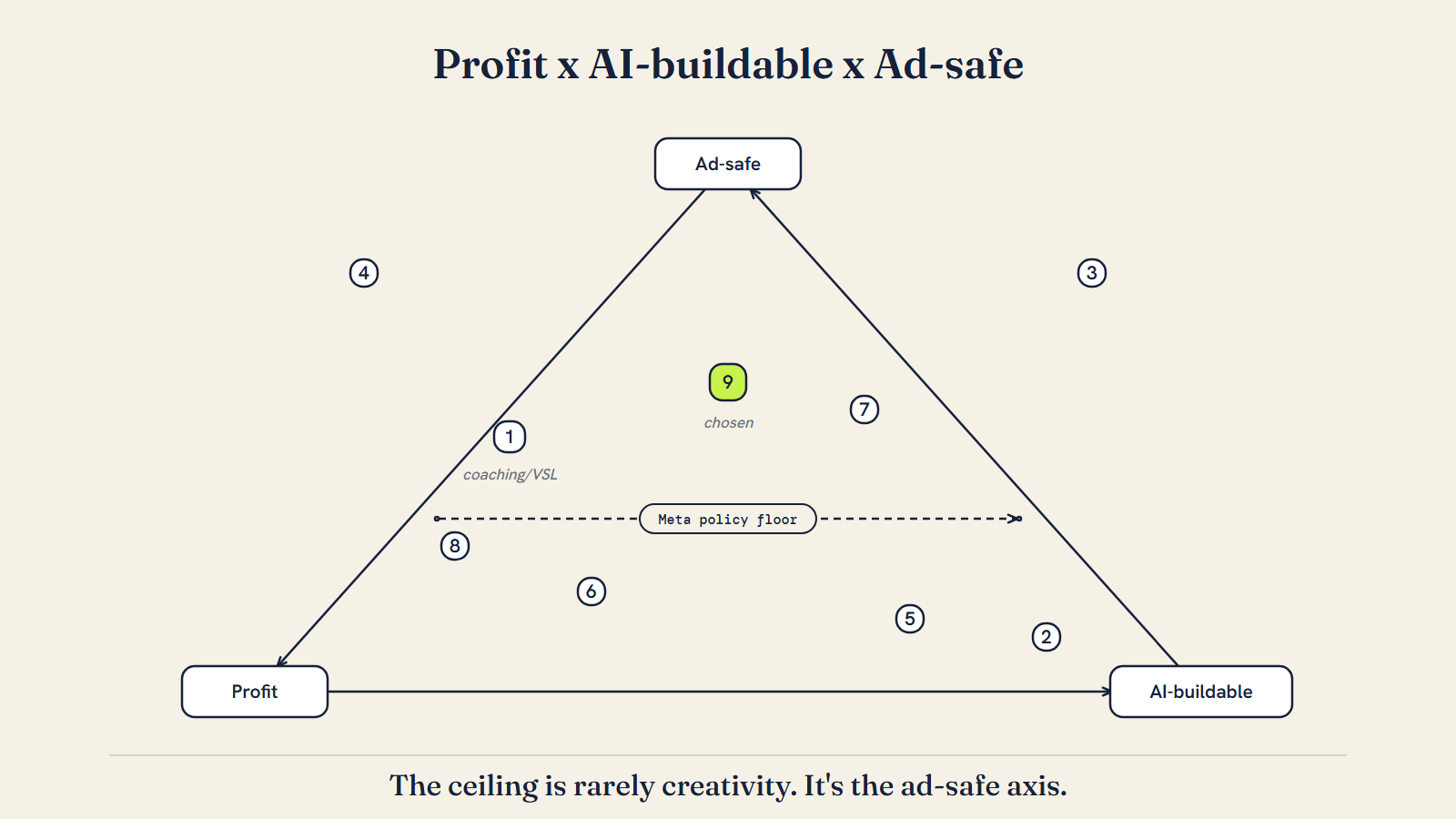
The third axis is the one people skip, and it's often the real ceiling. Meta removed 159 million scam ads in 2025 alone, using AI-driven proactive enforcement that checks the landing page as well as the ad itself, and advertiser verification is expanding to cover 90% of ad revenue by the end of 2026 — finance, crypto, investment education and work-from-home categories get heightened scrutiny regardless of whether the offer is legitimate.[^1] Layer onto that the FTC's proposed Earnings Claims Rule and its extension of the Business Opportunity Rule to money-making opportunities and business coaching, which would require three years of written substantiation for any earnings claim.[^2] Put those two together and a whole category of ideas — anything that leans on "here's what I made" as the pitch — is closed to you at the exact moment you'd want to scale it with ads. Not because the product is bad. Because the category is compliance-hostile.
That reframes the search. You're not looking for the most exciting idea. You're looking for the idea that scores acceptably on all three axes at once, because a 9/10 on profit and buildability with a 2/10 on ad-safety is a product you can make and can't advertise — which, for an ad-driven business, means you can't sell it at any scale that matters.
Worked example
On 5 September 2026, before Sundayclear existed under that name, the research pass that shaped it ranked nine possible niches by exactly this method — profit x AI-fit x ad safety — for a product "created mostly with AI" and "sold via Instagram/X with paid ads."[^3] Here is the ranked list, unrounded, as it was written:
- Faceless self-improvement / productivity digital product stack. Stan Store's own reporting puts its platform total above $400M paid out across more than 59,000 earning creators, at an average of $67 per sale; one cited case, a creator with 4,000 followers, saw a single guide generate $60,000 in its first two weeks.[^4] Fully AI-creatable, roughly 95% margin, low-to-moderate ad risk.
- AI-skills course with a paid challenge feeding a Skool membership — strong numbers, but flagged as "extreme saturation in generic 'make money with AI'," escapable only by going vertical (AI for accountants, for real-estate agents) and framing the offer as a skill, never as income.
- Spirituality and wellness workbooks with a challenge funnel — lowest ad risk of the nine, fully AI-creatable, but a narrower audience. 4 through 9 ranked lower for specific, named reasons: fitness needs a real coach's face on camera; digital planners see "99.5% of revenue to top 1%" on Gumroad, at a median $72 monthly; relationship coaching isn't AI-replaceable; high-ticket coaching needs a human closer and carries income-claim risk; MRR/PLR bundles are saturated and read as "business opportunity," a bannable frame outright; trading and crypto signal communities have the highest ban risk of all nine, plus EU rules that block financial-behaviour ad targeting entirely.
None of the nine won on every axis. The research file's own top recommendation was the first — faceless productivity, SLO funnel, Meta ads — and Sundayclear's founding plan built on it, but changed the audience: not general self-improvement, but one-person service businesses, because "ad driven info products are limited by Meta policy, not by product... nobody combines Claude-first + low ticket + bump/upsell/membership funnel + faceless brand."[^5] That's a profit and buildability argument. The ad-safety argument, stated as the plan's first design rule, was blunter still: "Sell time/systems only; never income," enforced later directly in code, not just in copy guidelines.
Scoring well on paper didn't make the execution easy. Later, Sundayclear's own first live ad test spent €174.55 to produce one $24.99 sale that Meta's own tracking never recorded — a targeting and placement failure, not an idea failure (you'll rebuild that exact test properly in Module 8). The scoring in this module tells you whether an idea is worth the attempt. It doesn't excuse you from running the attempt carefully.
Do this now
- List your three strongest product ideas, one line each, no elaboration yet.
- Score each on Profit, AI-buildable, and Ad-safe, 1 to 5, using the sheet below.
- For Ad-safe specifically, ask: could you describe this product's honest benefit in one sentence without any dollar figure, timeframe-to-income, or "guarantee" of a result? If no, score it low regardless of how good the product itself is.
- Optional: ask an AI model for a first-pass score, then correct it — it can't see your actual buildability constraints or your actual market access, only the category-level pattern.
- Circle the highest total. If two tie, pick the one with the higher Ad-safe score; that axis is the one that determines whether you can reach buyers at all.
IDEA-SCORING SHEET

Idea 1: [ONE LINE]
- Profit (1-5): [ ]   Why: [is there a market already spending money on something adjacent?]
- AI-buildable (1-5): [ ]   Why: [can an AI model produce the actual deliverable at sellable quality?]
- Ad-safe (1-5): [ ]   Why: [can you describe the benefit honestly, with no income or results claim?]
- Total: [ ] / 15

Idea 2: [ONE LINE]
- Profit (1-5): [ ]   Why:
- AI-buildable (1-5): [ ]   Why:
- Ad-safe (1-5): [ ]   Why:
- Total: [ ] / 15

Idea 3: [ONE LINE]
- Profit (1-5): [ ]   Why:
- AI-buildable (1-5): [ ]   Why:
- Ad-safe (1-5): [ ]   Why:
- Total: [ ] / 15

Chosen idea: [ ]   Reason (one sentence, no adjectives): [ ]
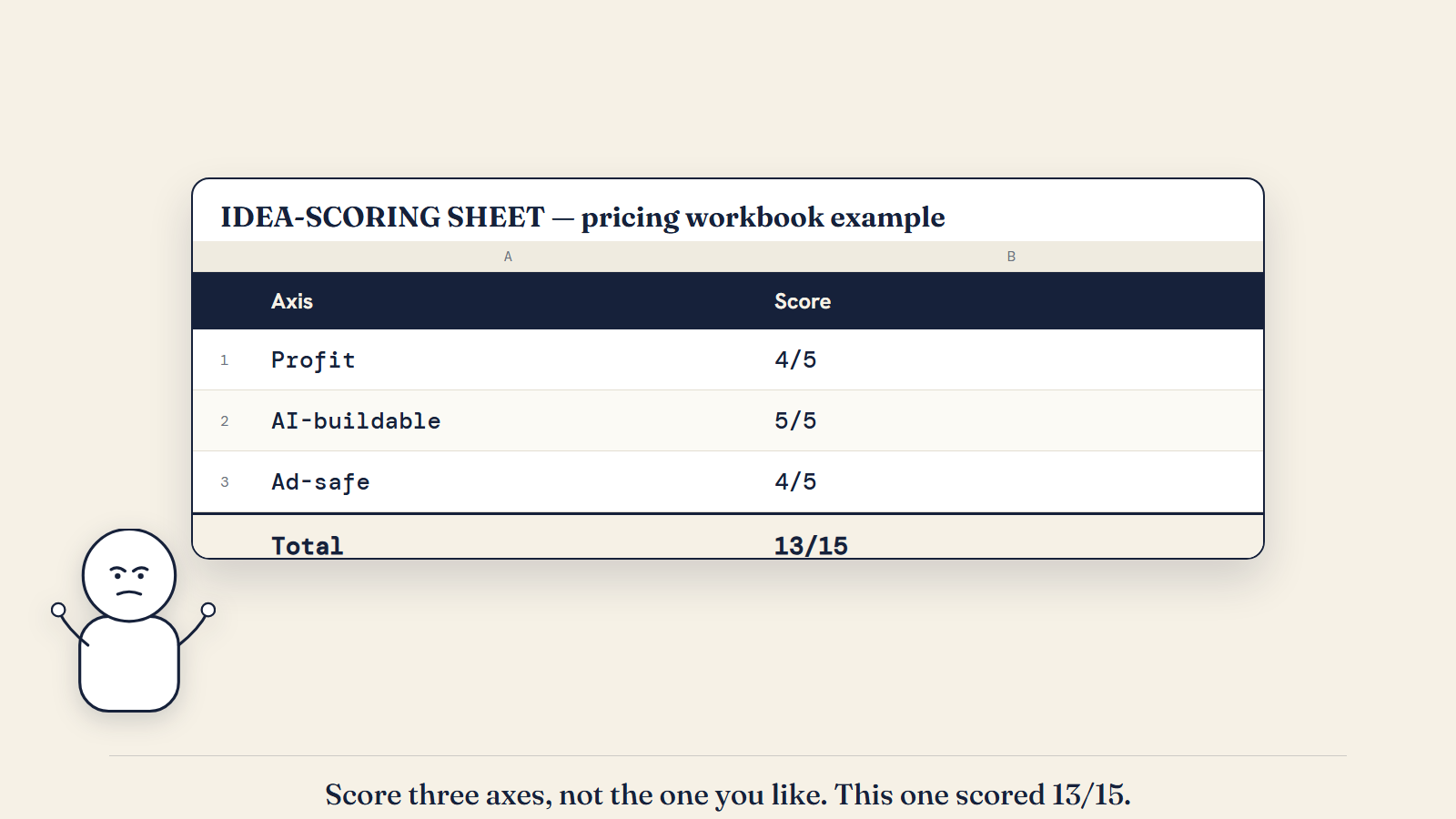
Here is that optional AI pass, run on a realistic (fictional) idea, so you can see what a first-pass score actually looks like before you correct it. Prompt: "Score this digital product idea on three axes, 1 to 5 each, for a solo creator selling via Instagram/X ads: 'a workbook that helps freelance photographers build a repeatable pricing structure.' Axes: profit potential (is there a market already paying for adjacent things), AI-buildability (can the deliverable be produced mostly by an AI model at sellable quality), ad-safety (can the benefit be described honestly with no income or results claim). Give a score and one reason per axis, then a total."
Produced with Claude on 18 September 2026:
Profit: 4/5. Freelance photographers already pay for Lightroom presets, contract templates and pricing courses, so this sits next to proven spending, not ahead of it. AI-buildable: 5/5. A pricing workbook is structured text and calculators, well within what a model can draft to a high standard from a clear brief. Ad-safe: 4/5. The honest pitch is "stop guessing your day rate," a systems claim with no income or results promise attached. Score isn't 5 only because "pricing" content sometimes drifts into implied earnings language if you're not careful with the copy. Total: 13/15.
Notice what it didn't do: it didn't know whether you can actually reach 20,000 freelance photographers on Instagram, or whether you personally have the credibility to write pricing advice. Those are yours to add.
Check
- I scored three distinct ideas, not three versions of the same idea.
- Each score has a one-line reason, not just a number.
- I can state my chosen idea's benefit in one sentence with no dollar figure or income claim.
- I checked my Ad-safe score against Meta's actual restricted-goods policy, not just my gut.
- My highest-scoring idea isn't automatically the one I liked best before scoring.
- I know which axis is my idea's weakest, and what would need to be true to raise it.
If you are stuck
The most common failure is scoring Profit and AI-buildable honestly, then waving Ad-safe through because "I'd never actually lie in my ads." That misses the point: the policy checks the pattern (dollar figures, timeframes, guarantees), not your intent. Read your own idea's one-sentence pitch back and see if it survives with every number and every "you'll be able to" removed. The second failure is picking the idea that scored highest on paper but that you have no real way to reach — scoring tells you what's worth building, not who's going to see it. If your top idea has no plausible audience you can name by Monday, its Profit score was too generous.
Sources
[^1]: Meta Transparency Center, "Fraud, scams and deceptive practices" — 159 million scam ads removed in 2025, AI-driven proactive enforcement, advertiser verification expanding to 90% of ad revenue by end-2026: https://transparency.meta.com/policies/ad-standards/fraud-scams/fraud-scams-deceptive-practices/ [^2]: FTC press release, January 2025, proposed Earnings Claims Rule and Business Opportunity Rule extension: https://www.ftc.gov/news-events/news/press-releases/2025/01/ftc-proposes-rule-changes-new-rule-deter-deceptive-earnings-claims-multilevel-marketers-money-making [^3]: Our internal research notes from 5 September 2026, "Product/niche evidence, ranked by profit x AI-fit x ad safety" [^4]: same notes, item 1, citing Stan's own creator-earnings reporting and case study (sources listed at the foot of that file) [^5]: Our internal master plan from 5 September 2026, "Why this and not something else"
Unlocked