Module 1 of 8 in Money, for people who work for themselves
Know your real number
You know last quarter's actual profit, not revenue, and where the next 90 days of it needs to live.
25 minutes Free
0 of 8 modules done
Education, not personalised financial or tax advice. Rules change; check the linked official source for your country before acting.
The invoice cleared. $14,200 landed across six deposits this quarter, and for about a day that number feels like the answer. Then a card payment bounces because the "real" balance is lower than the app's headline number, and you're doing the math you should have done on payday: how much of that was ever actually yours.
Outcome
By the end of this module you will have calculated last quarter's real profit, not revenue, and split it across three accounts so you stop finding out the hard way what was never spendable.
The idea
Revenue is what clients paid you. Profit is what's left after the cost of doing the work. Take-home is what's left after taxes, and it's always the smallest of the three numbers, and the only one that actually describes what you can spend. Most people who work for themselves track the first number closely, because it's the one the banking app shows them, and barely track the other two, because they require a subtraction nobody does automatically.
The subtraction is simple: profit equals revenue minus real business expenses. Software subscriptions, equipment, a portion of a home office, professional fees — whatever you legitimately spent to do the work this quarter. Skip this step and every decision downstream is wrong: you'll feel richer than you are in a big-invoice month and poorer than you are in a quiet one, and you'll set aside tax money against the wrong figure, because tax is owed on profit, not on what landed in your checking account.
That's the trap behind "a good month can still be a loss." Revenue and profit move independently. A freelancer who bills $9,800 in a month feels like they've had a great one — until a $9,200 equipment replacement in that same month turns it into a $600 profit month, indistinguishable from a quiet one in every way that matters for tax and take-home. The invoice total told them nothing useful about how the month actually went. Only the subtraction did.
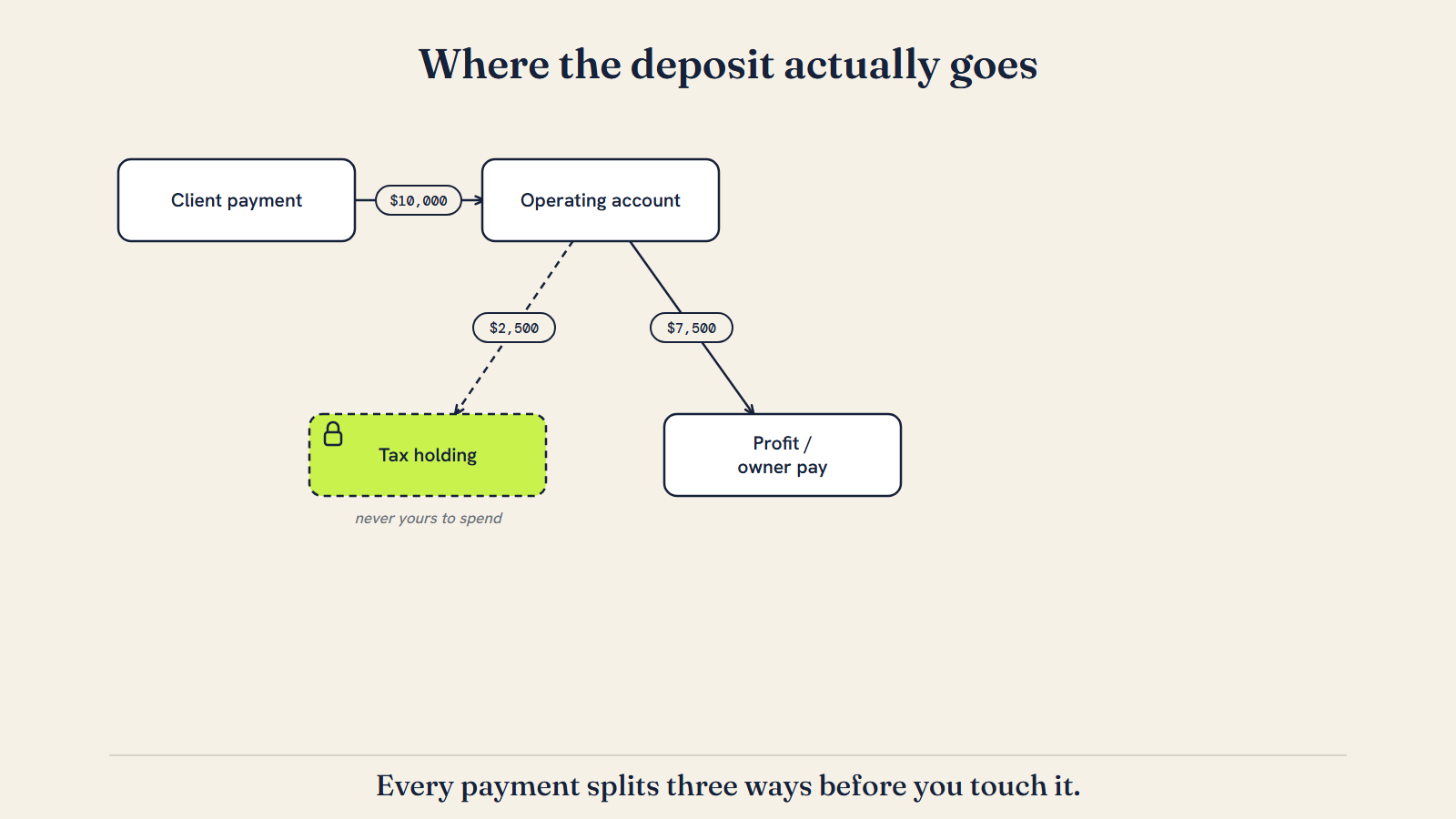
The fix isn't a better feeling about money, it's a structure that makes the subtraction happen automatically, before you get a chance to spend against the wrong number. That structure is three accounts, not one:
- Operating — where client payments land and where business expenses get paid from. This account carries a float you choose (commonly a month or so of fixed costs) and nothing more.
- Tax holding — money that was never yours to begin with. A fixed percentage of every invoice's profit moves here the same day the payment clears, not at the end of the quarter. This account only ever pays the tax authority.
- Profit / owner pay — what's actually yours. Whatever's left in operating above your chosen float gets swept here on a schedule (monthly or quarterly), and from here you pay yourself, save, or reinvest, on purpose rather than by whatever happens to be sitting in checking.
The order matters. Tax holding is funded first, off the top, same-day. Owner pay is funded last, off what's left. Reverse that order — spend first, set aside whatever's left before the deadline — and you're the person discovering in April that the "extra" money in checking was never extra.
Worked example
Alex is fictional, invented for this course; the arithmetic below uses real percentages you can apply to your own numbers. Alex is a video editor in the US. Here's his second quarter, pulled from his invoicing tool and bank export, not from memory.
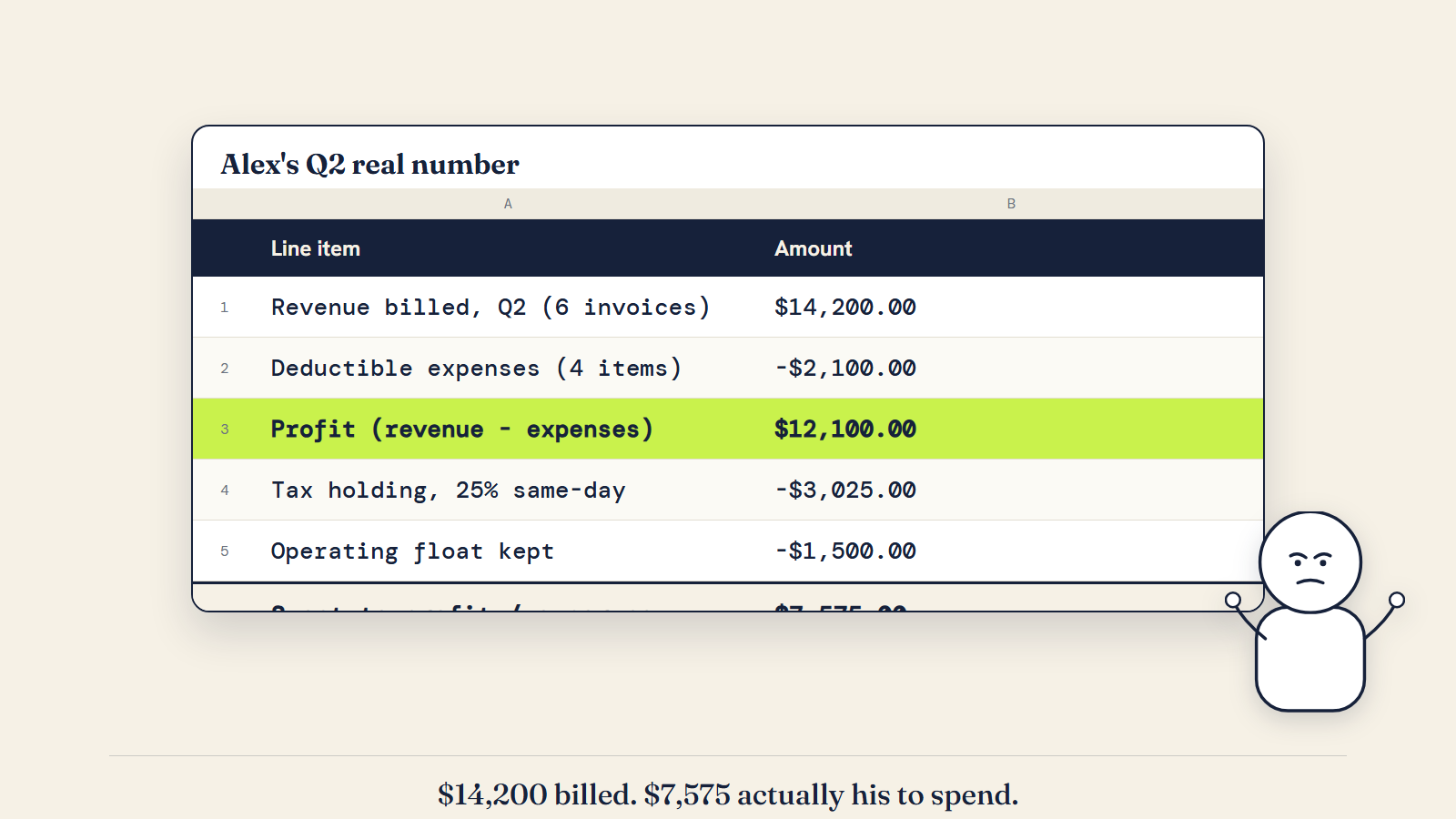
Revenue billed, Q2 (April–June): six invoices totalling $14,200.
Deductible business expenses, same quarter: a replacement hard drive ($340), two months of editing software subscriptions ($220), a portion of home internet allocated to business use ($140), and a conference registration ($1,400) — $2,100 total, pulled from card statements, not estimated.
Step 1 — the real number: $14,200 (revenue) − $2,100 (expenses) = $12,100 profit.
That's the number Alex should have been reacting to all quarter, not the $14,200 that hit his account in pieces.
Step 2 — fund tax holding, same day, off the top. A commonly cited range for a US freelancer's combined federal tax set-aside is 25–30% of profit, moved to a separate account as it's earned (NerdWallet, checked 18 Sep 2026). Alex uses the conservative end of that range for now — Module 2 of this course shows how to calculate his exact self-employment tax to the cent and compare it against the IRS safe-harbor rule, which will sharpen this number. For this quarter:
25% × $12,100 = $3,025 moved to tax holding.
Step 3 — set the operating float and sweep the rest. Alex's fixed monthly costs (software, insurance, a portion of rent) run about $1,500. He keeps that as his float in operating and sweeps everything above it.
- Operating balance after expenses and the tax sweep: $12,100 − $3,025 = $9,075
- Float he keeps in operating: $1,500
- Swept to profit / owner pay this quarter: $9,075 − $1,500 = $7,575
$7,575 is what Alex actually has to pay himself, save, or reinvest from this quarter — not the $14,200 the deposits added up to, and not even the $12,100 profit figure, because some of that profit was never his to spend in the first place.
Why a good month can still be a loss, in numbers: if Alex's biggest invoice month this year was $9,800, but $9,200 of it went straight to replacing a broken camera body and lens, that month's profit is $600 — a loss compared to almost any other month, despite being his single largest invoice total of the year. Revenue alone would have called it his best month. The subtraction called it correctly.
Do this now
- Pull last quarter's total invoiced amount from your invoicing tool or bank deposits — the real figure, not a rounded guess.
- List every deductible business expense from the same period from your bank/card statements, and total them.
- Subtract expenses from revenue. Write down the result. That's your real profit.
- Open a second account or a named savings pocket if you don't already have one — this is your tax holding account.
- Move 25–30% of this quarter's profit into it today.
- Decide your operating float in a real dollar figure, then sweep whatever's above it in operating into a third account or pocket for profit/owner pay.
- Fill in the 90-day snapshot below with your own numbers.
THREE-ACCOUNT SETUP

1. OPERATING — where invoices land, where expenses get paid
   Float I keep here: $____
   Everything above the float moves out on my money day.

2. TAX HOLDING — never mine to spend
   Moves in: 25-30% of profit, same day the invoice clears
   Moves out: only to the tax authority, on the due dates (see Module 2)

3. PROFIT / OWNER PAY — what's actually mine
   Moves in: whatever's left in operating above my float, swept monthly or quarterly
   Moves out: to myself, to savings, or back into the business, on purpose

90-DAY SNAPSHOT
Revenue billed:                    $____
Expenses paid (from statements):   $____
Profit (revenue - expenses):       $____
Moved to tax holding:              $____
Swept to profit / owner pay:       $____
Check
- I calculated profit as revenue minus actual, statement-pulled expenses, not revenue alone.
- I have three separate accounts or named pockets, not one account doing all three jobs.
- I moved money into tax holding the same day an invoice cleared, not at quarter-end.
- I can name my operating float as a real dollar figure, not "whatever's left."
- I know what "swept to profit" means for my business this quarter, in dollars.
- I filled in the 90-day snapshot with real numbers, not estimates from memory.
If you are stuck
If everything still lives in one account, the fix isn't a better spreadsheet, it's opening the second account today — even funding it with $50 to start builds the same-day habit before the real money arrives. If your expense list feels incomplete or guessed, don't estimate it: pull an actual export from your bank or card provider for the quarter. A profit number built on a guessed expense list will quietly overfund or underfund your tax account for months before you notice.
A third, quieter failure mode: treating the profit/owner-pay sweep as optional in a slow month, so money just accumulates in operating "for now." Left alone, that pile stops feeling like profit and starts feeling like a buffer against every future expense, which is a different job with a different account in this same system — do the sweep on schedule even when the number is small, so the habit survives the months it matters most.
Sources
- IRS, Estimated Taxes FAQ — checked 18 Sep 2026
- NerdWallet, business bank accounts and tax set-aside guidance for freelancers — checked 18 Sep 2026
Unlocked