Module 1 of 8 in First ten clients
Say what you do in one sentence
A one-sentence offer a stranger understands on first read, plus three proof points to back it up.
25 minutes Free
0 of 8 modules done
Your website says "I do photography for small businesses." It's been up for two years. Nobody's ever pointed at it and said, "that's exactly what I need." They scroll past it the way you scroll past everyone else's.
Outcome
By the end of this module you'll have one sentence that names who you help, what they get, and how, specific enough that a stranger could say yes or no to it on first read, plus three proof points to back it.
The idea
A vague offer doesn't get rejected. It gets ignored, which is worse, because you never find out why. "I do photography for small businesses" is true of thousands of people, so it asks the reader to do the work of figuring out if you're for them. Most people don't do that work. They keep scrolling.
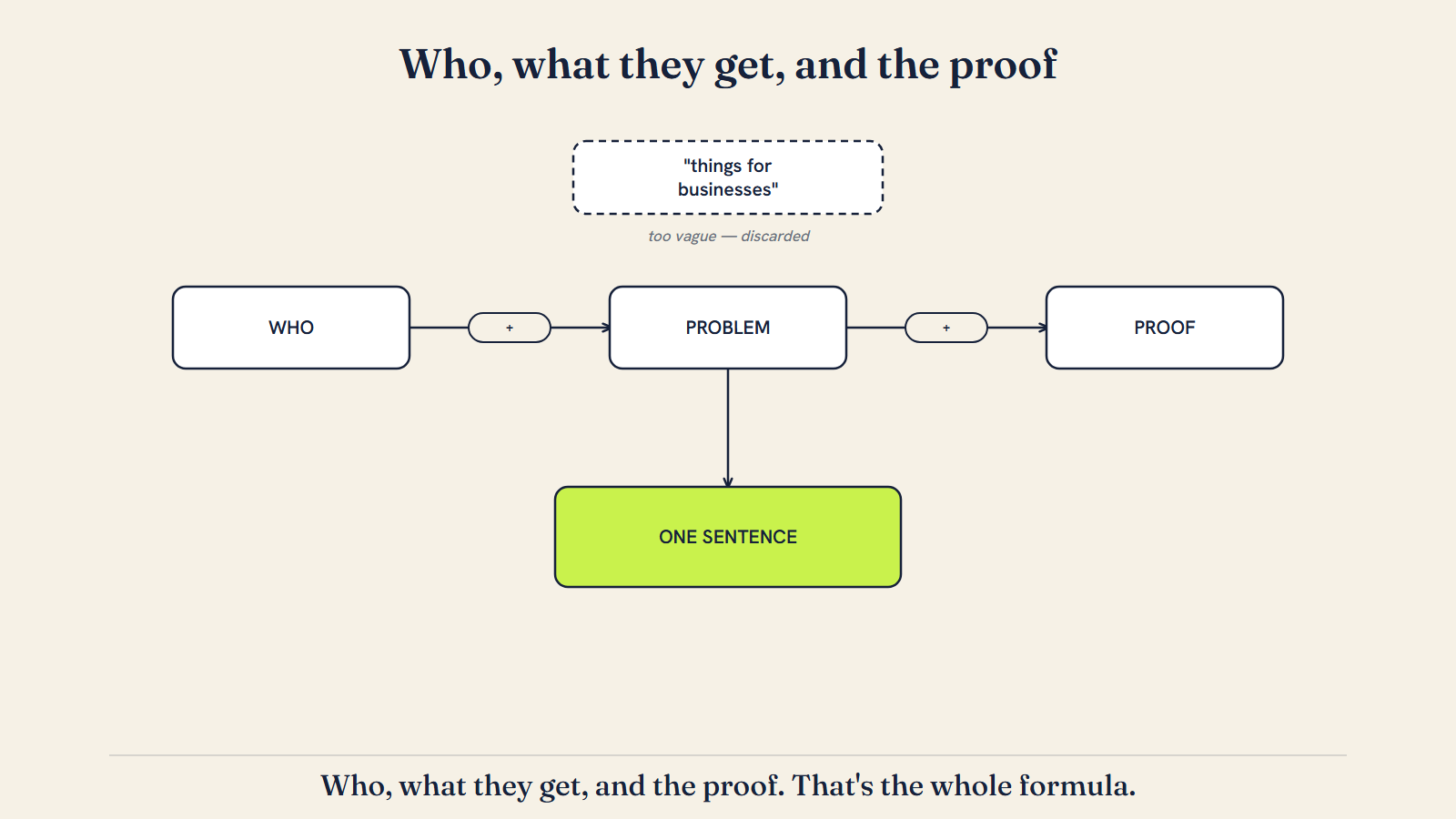
The fix isn't cleverness, it's specificity. A one-sentence offer has three parts: who (a narrow enough group that a real person in it would nod), what they get (the actual outcome or deliverable, not "solutions"), and proof or mechanism (a detail that makes the sentence credible, not aspirational). "I write and post 3 Instagram Reels a week for busy dog groomers who have no time to film" has all three: who (dog groomers, busy, no time to film), what (3 Reels a week, written and posted, not "content strategy"), and an implied mechanism (someone else does the filming problem for you). A dog groomer reading that sentence knows in one pass whether it's for them. A generic "social media help for small businesses" sentence gives them nothing to check against.
Niche language matters more than clever language here. "Solutions", "synergy", and "help you grow" are marketing-speak: words a business owner has seen a hundred times and learned to skip past. "Busy dog groomers who have no time to film" is niche language: words an actual dog groomer uses about their own week. The narrower and more concrete the words, the more likely they match how your actual buyer already describes their own problem. This is also why "I help small businesses" fails even when it's accurate. Small business owners don't think of themselves as "a small business." A dog groomer thinks of themselves as a dog groomer.
This module doesn't touch price. A sharp one-sentence offer and a well-priced package are separate
problems, and trying to fix both in one sentence usually makes the sentence worse (see the diagram:
proof comes from a result or detail, not from a number). If pricing structure is what's actually
bothering you, price-a-service-package.md on the Sundayclear site covers tiered pricing and the
anchoring effect separately.
The tool for turning a vague description into this sentence is the offer sharpener, a ten-minute prompt that asks for what you do, who you've actually worked with, one result you're proud of, and what you want more of, then returns five one-sentence offers with different angles, not one guess.
Worked example
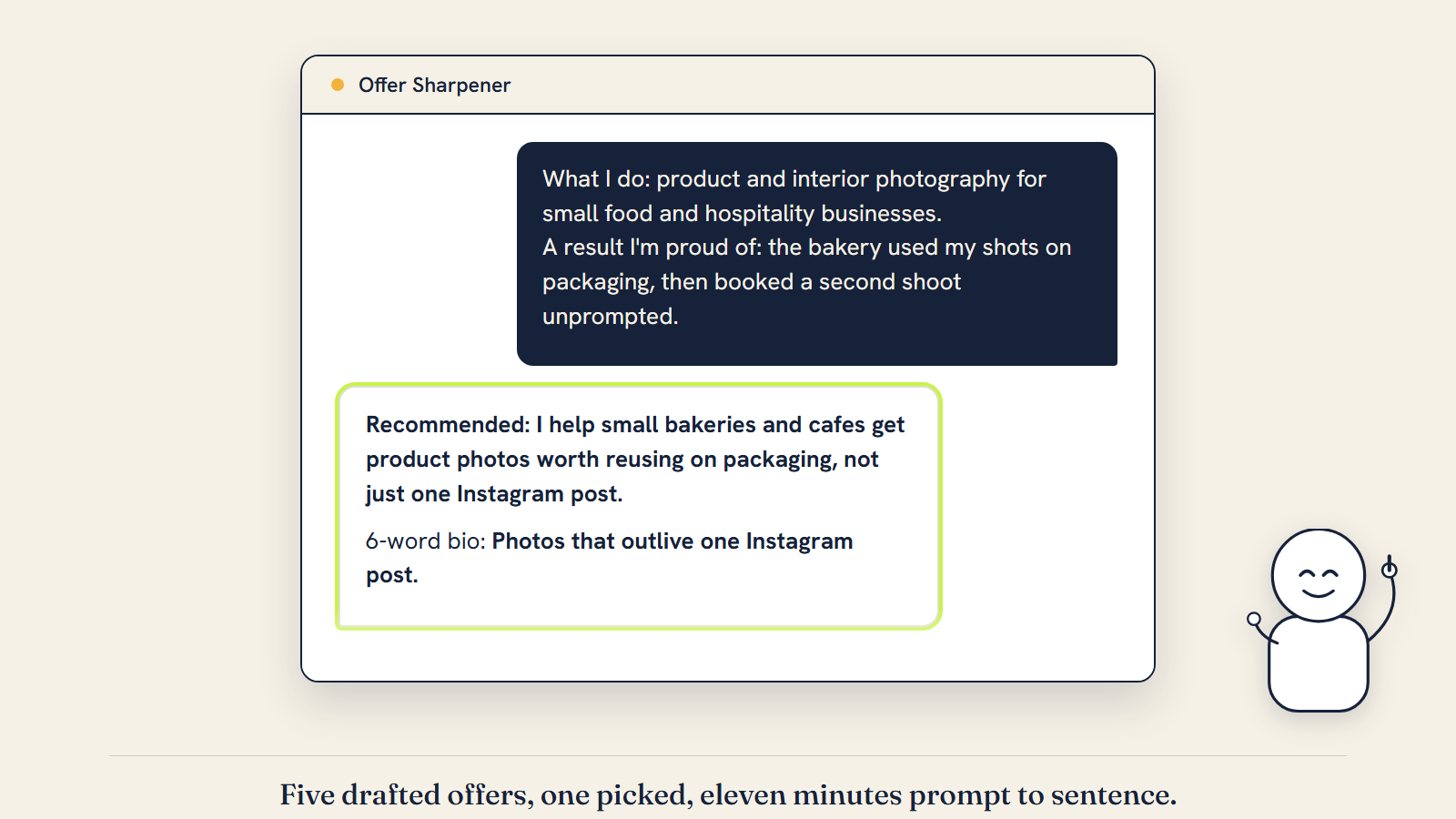
Sanna Ojala is a fictional freelance photographer in Turku, Finland, used here so the prompt and its output are concrete instead of hypothetical; the offer sharpener task and the output below are real. Sanna left an in-house marketing job eight months ago and now shoots product and interior photography for small businesses. Her website currently says: "I do photography for small businesses." She's had two enquiries in three months, both from people who wanted wedding photography, which she doesn't shoot.
Here is exactly what she pasted into the offer sharpener prompt from 01-offer-sharpener.md:
Context about me:
- What I do: I do product and interior photography, mostly for small food and hospitality
  businesses. I shoot for their website, menu, and Instagram.
- Who I have actually worked with: a bakery chain (3 locations), a boutique hotel, a personal
  trainer's studio
- A result I am proud of: the bakery used my product shots on their packaging and website, then
  booked a second shoot for their new location without me following up
- What I want more of: more food and hospitality businesses, especially ones opening a second
  location or refreshing their menu or branding
And the full output it returned, produced with Claude on 18 Sep 2026:
| # | One-sentence offer | 6-word bio line | Angle |
|---|---|---|---|
| 1 | I shoot product and interior photos for food and hospitality businesses opening a second location or refreshing their menu. | Photos for your second location launch. | specialism |
| 2 | I help small bakeries and cafes get product photos worth reusing on packaging, not just one Instagram post. | Photos that outlive one Instagram post. | outcome |
| 3 | I photograph food and hospitality spaces for businesses too busy running service to plan and shoot it themselves. | Done-for-you photos, zero shoot planning. | done-for-you |
| 4 | I shoot the product and interior photos a growing bakery or hotel needs before a menu refresh or new location. | Photos ready before your next launch. | speed |
| 5 | I help hospitality owners replace phone photos with images they'd actually put on packaging. | Packaging-ready photos, not phone photos. | certainty |

Recommended: #2 because it names a concrete, checkable outcome (photos reused on packaging, not a
single post) that a bakery or cafe owner can measure against their own last shoot, and it uses the
bakery result you already have as proof rather than a claim.

Proof to collect:
1. The bakery's packaging or website page actually using your product shots.
2. A short quote from the bakery owner about booking the second shoot unprompted.
3. A before/after: a phone photo the client used previously next to one of your shots.
Sanna picked #2, dropped "small" (her clients aren't tiny, and the word added nothing), and put "Photos that outlive one Instagram post" as her Instagram bio line. The whole run, prompt to picked sentence, took eleven minutes.
Do this now
- Write down, in your own words, what you do, who you've actually worked with (2-3 real client types, not aspirational ones), one result you're proud of, and what you want more of.
- Run the prompt below with your real inputs, in Claude, ChatGPT, or the prompt builder.
- Read all five offers out loud. Cross out any that only work in a marketing meeting, not in a hallway conversation.
- Pick one. If two audiences genuinely need different sentences, run it twice, once per audience, rather than writing one sentence that half-fits both.
- Write down the three proof points it suggests, then note next to each one whether you already have it or need to collect it.
- Put the winning sentence at the top of your bio, your proposal template, and the first line of your next outreach message.
OFFER SHARPENER PROMPT (Task 01, Offer Sharpener, in the AI Business OS)

You are a positioning editor for one-person service businesses. Your job is to turn what I do
into an offer a stranger understands in one read.

Context about me:
- What I do: [WHAT YOU DO, IN YOUR OWN WORDS]
- Who I have actually worked with: [2-3 PAST CLIENT TYPES]
- A result I am proud of: [ONE CONCRETE RESULT, NO REVENUE FIGURES NEEDED]
- What I want more of: [THE KIND OF CLIENT OR PROJECT]

Task:
1. Write 5 one-sentence offers in the form "I help (who) (get what) (without / by / in)".
   Vary the angle: speed, certainty, specialism, done-for-you, outcome.
2. For each, give a 6-word version for a bio line.
3. Pick the strongest one and explain in two sentences why a busy buyer would prefer it.
4. List 3 proof points I should collect to back it up.

Constraints: plain English, no buzzwords, no promises about money. If any input above is
missing, ask me one question, then continue. Output using the template below.

---
OFFER TABLE

| # | One-sentence offer | 6-word bio line | Angle |
|---|---|---|---|
| 1 | | | |
| 2 | | | |
| 3 | | | |
| 4 | | | |
| 5 | | | |

Recommended: #_ because ...
Proof to collect: 1. ... 2. ... 3. ...
Check
- My offer names a specific "who", narrow enough that a real person in it would recognise themselves.
- It names an actual outcome or deliverable, not "solutions" or "help".
- A stranger could say yes or no to it after reading it once, without asking a follow-up question.
- It contains no word I'd have to explain in a meeting ("synergy", "holistic", "growth partner").
- I have at least one of the three proof points already, or a plan to get it this month.
- I've put the sentence somewhere it'll actually get read: bio, proposal header, or outreach opener.
If you are stuck
The most common failure is picking the offer that sounds most impressive in a meeting instead of the one that's most specific in a hallway. If you're torn between two, read each one to someone outside your industry; the one they can repeat back to you correctly is the one that works. The second failure is having nothing for "a result I am proud of" because you haven't been in business long enough or haven't tracked it. If that's you, use the smallest real thing you've got: one client who came back, one piece of feedback you can quote, one thing you made that someone actually used. A small true result beats an invented big one every time, because the sentence only works if it's checkable.
Sources
- Task 01, Offer Sharpener, AI Business OS
- Sundayclear guide, How to price a service package, not just a day rate
- Good-better-best pricing, Wikipedia
Unlocked