Module 1 of 8 in A small shop online
Pick the one thing and price it honestly
One product chosen to sell, with a real margin number per unit and a monthly total at the volumes you're actually weighing up.
30 minutes Free
0 of 8 modules done
You've picked a price the way most people do: you looked at what similar things sell for, added a bit for your time, and called it done. Nobody told you that a $28 sale doesn't pay you $28, or that the gap between the sticker price and what lands in your account depends on decisions you haven't made yet — which platform, which payment processor, how you costed your materials in the first place. You can build a whole shop around a product before you find out its margin barely covers the electricity.
Outcome
By the end of this module you'll have one product chosen to sell, with its real margin worked out per sale and at the monthly volumes you're actually considering, using current, sourced fee rates instead of a guess.
The idea
Margin is not price minus what the thing cost you to make. It's price minus everything that comes out before you see a cent: the platform's listing and transaction fees, the payment processor's cut, and then, only after those, your cost of goods. Skip a term and the number you're left with is fiction, and fiction is a bad thing to build a shop on.
The formula is short: margin = price − platform fees − payment fees − cost of goods. Platform fees vary by where you sell (a marketplace like Etsy charges differently from a storefront you run yourself on Shopify), payment fees are close to fixed regardless of platform (somewhere around 2.9–3% plus a flat 25–30 cents per US card charge, whether the processor is Stripe, PayPal or a marketplace's own built-in processor), and cost of goods depends on what you're selling: a handmade item's cost is materials plus your time in production inputs (clay, glaze, kiln electricity), while a print-on-demand item's cost is whatever the supplier charges you per unit before you've made anything — commonly documented for standard apparel at roughly a 40% margin before marketplace fees, with one supplier undercutting another by 20–30% on the same blank.[^1] Concretely: a standard Bella+Canvas tee run through Printful's base cost of roughly $11.50, sold at $24.99, clears about 40% margin before Etsy or Shopify take their own cut — the same four-term formula as Marta's mug, run against a supplier's price list instead of a materials receipt.
Whichever cost structure applies to you, the formula doesn't change; only which line is easy to verify does. A handmade seller can weigh clay on a kitchen scale and time a kiln cycle to the minute. A print-on-demand seller reads the supplier's published price list directly, with no weighing involved, but should still check it on the day of costing, since suppliers revise base prices without much notice.
Narrow scope beats a full catalogue here, and it's not a taste preference — it's arithmetic. Every extra product you list is another set of these four subtractions to track, another set of materials to buy and store, another photo shoot. One product with a margin you've actually calculated and trust beats five you've priced by eyeballing a competitor's page. This module picks that one product and does the sum properly; later modules build the shop around it.
One more thing before the worked example: the maker in it, Marta, is fictional. The fee percentages, the platform rules and the supplier numbers she's plugged into her arithmetic are real, current as of the sources at the bottom of this page, and exactly what you'd get plugging your own numbers into the same formula.
Worked example
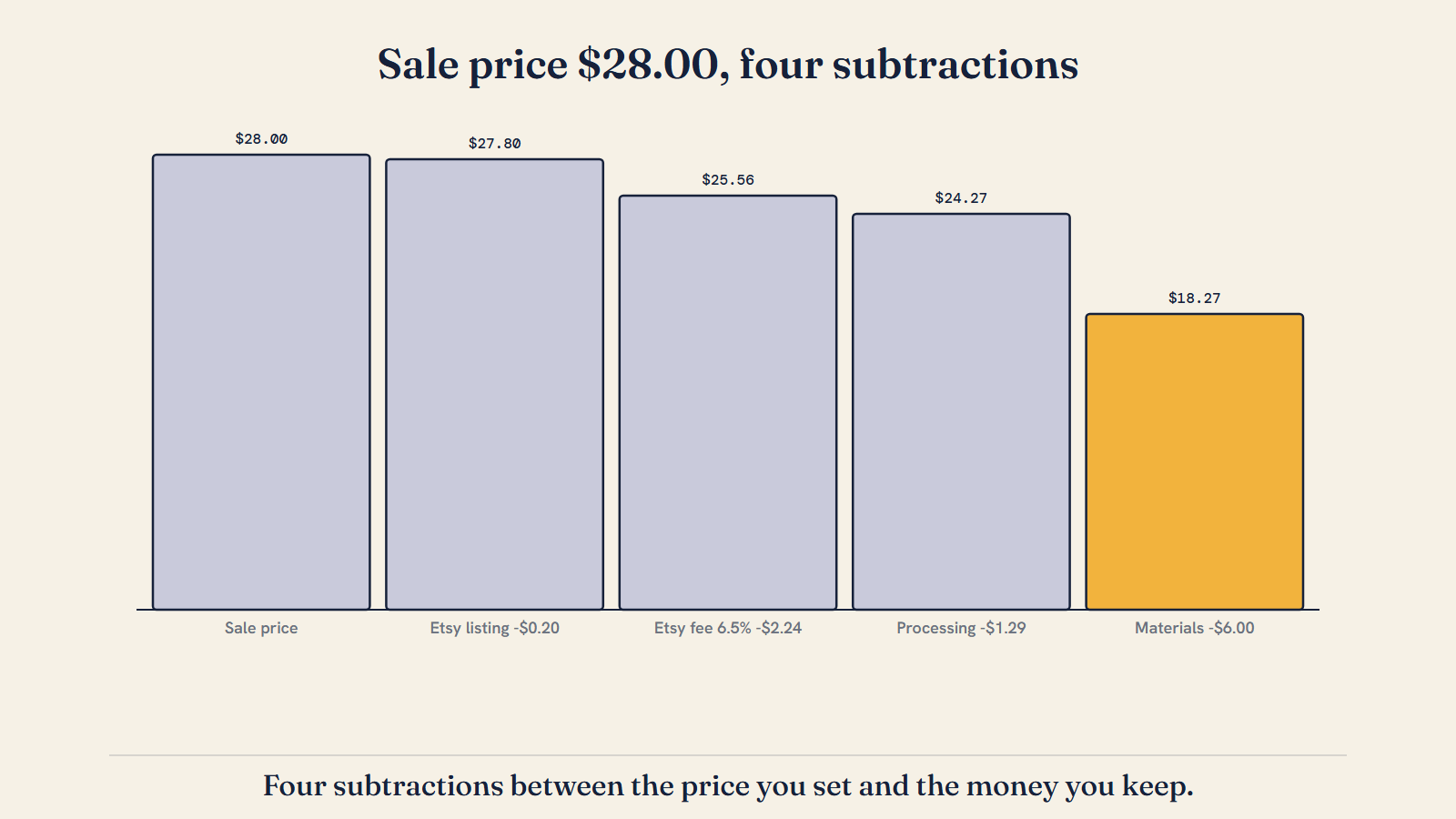
Marta hand-throws ceramic mugs from a home studio and sells one design: a 350ml stoneware mug, wide weighted base, oat-coloured glaze, fired to 1,280°C. She lists it at $28.00 on Etsy and charges $6.50 for US domestic shipping — a number she picked because it's what USPS Ground Advantage actually costs her to ship a padded mug box at that weight, so shipping is priced to break even rather than to pad her margin.[^2]
Her cost of goods, itemised instead of guessed:
| Line | Cost |
|---|---|
| Clay and glaze | $3.50 |
| Kiln firing (electricity, amortised per piece) | $1.50 |
| Packaging (box, wrap, tape) | $1.00 |
| Total cost of goods | $6.00 |
Etsy's fees, on the full order value of $34.50 (the $28.00 item plus $6.50 shipping — Etsy's transaction fee applies to both, not just the item price):[^1]
| Fee | Rate | Amount |
|---|---|---|
| Listing fee | $0.20 flat, per listing (runs four months or until sold) | $0.20 |
| Transaction fee | 6.5% of item + shipping | 6.5% × $34.50 = $2.24 |
| Payment processing | ~3% + $0.25 | (3% × $34.50) + $0.25 = $1.29 |
| Total Etsy fees | $3.73 |
Because Marta's $6.50 shipping charge equals her actual shipping cost, it cancels out of the margin sum. What's left:
$28.00  sale price
- $3.73  Etsy fees (listing + transaction + payment processing)
- $6.00  cost of goods (clay, glaze, firing, packaging)
= $18.27 margin per mug (65.3% of the item price)
That's the number the spreadsheet shows her: not the $28 she quotes a customer, and not some round "aim for 50%" rule of thumb, but $18.27, arrived at by subtracting four real things in order.
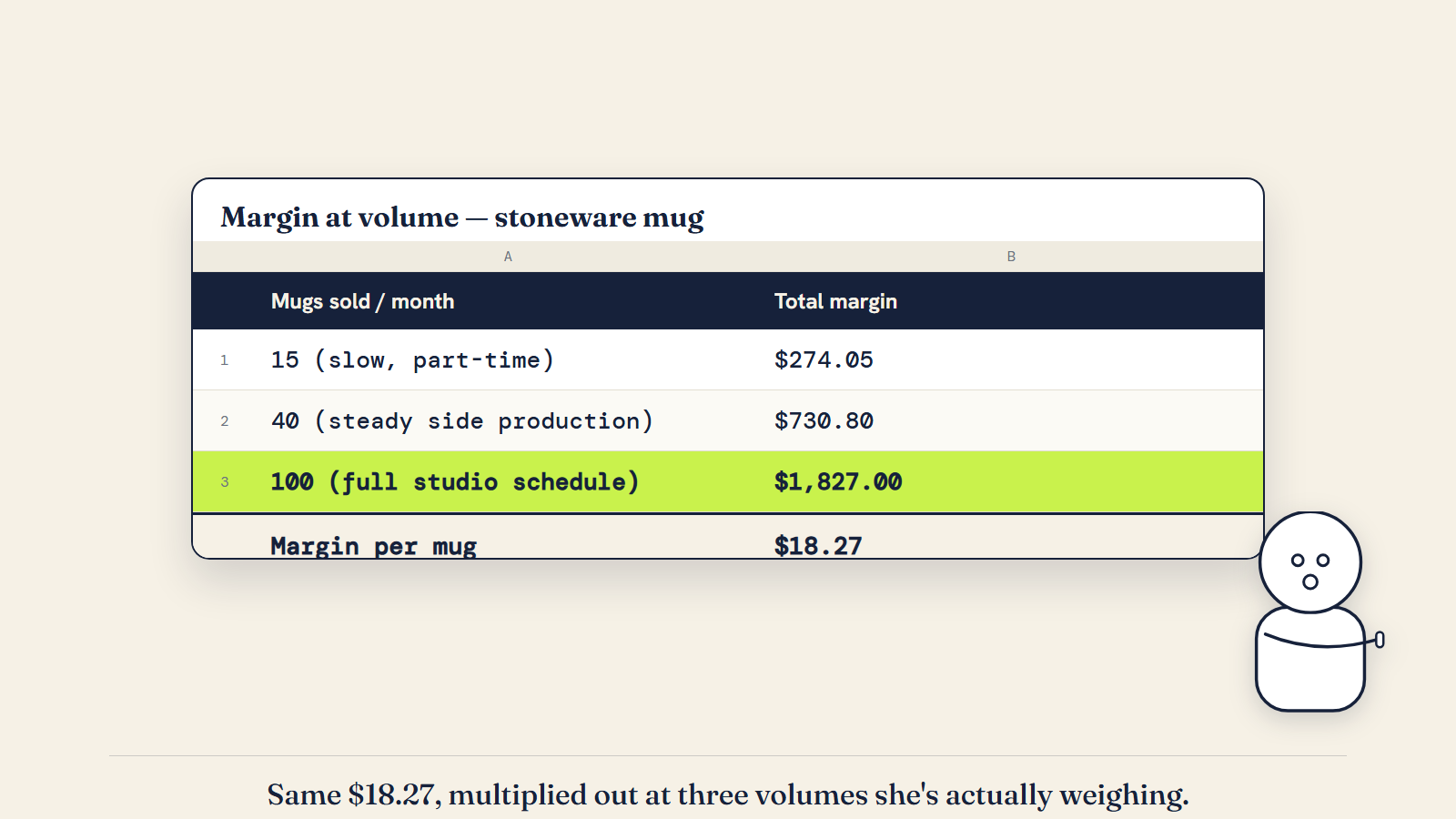
At volume. Margin per unit only tells you what one sale is worth. Before picking a product, Marta also multiplies it out at three monthly volumes she's genuinely weighing — not a forecast of what she will sell, just her own number multiplied, so she can see whether the product is worth the shelf space and studio time at each scale:
| Mugs sold, per month | Total margin before her own time, marketing or platform ads |
|---|---|
| 15 (slow, part-time) | $274.05 |
| 40 (steady side production) | $730.80 |
| 100 (full studio schedule) | $1,827.00 |
These three rows are Marta's own arithmetic on her own verified per-unit number, not a projection of what any shop will actually sell — nothing here promises a particular volume is realistic for a first product. What the table does show is the shape of the decision: at 15 mugs a month the product covers materials and a little else; at 100 it starts to look like it could justify the studio time. That's the comparison to make before you commit to a product, not after.
Do this now
- Pick the one product you'll take through this course — your best seller, or the one you know best, not your whole catalogue.
- Write down its real sale price and your actual shipping charge (not a guess — check what your carrier would charge for that weight and box today).
- Itemise your cost of goods the way Marta's table does: materials, production overhead (firing, printing, assembly time you're pricing as a cost), packaging. No round numbers.
- Look up the actual fee schedule for the platform you're leaning toward (Etsy, Shopify, or your payment processor directly) and use its current published rate, not last year's.
- Fill in the margin sheet below with your own four numbers.
- Multiply your per-unit margin by two or three monthly volumes you're actually considering, the way Marta did, so you can see the shape of the decision before Module 2 picks a channel.
MARGIN SHEET

Product: [WHAT YOU'RE SELLING]
Sale price (to buyer): $[X]
Shipping charged to buyer: $[X]      Actual shipping cost: $[X]

Cost of goods:
  Materials: $[X]
  Production overhead (firing / printing / assembly time as cost): $[X]
  Packaging: $[X]
  Total cost of goods: $[X]

Platform + payment fees (use the platform's current published rate):
  Listing fee (if any): $[X]
  Transaction fee: [X]% × (item + shipping) = $[X]
  Payment processing: [X]% + $[X] = $[X]
  Total fees: $[X]

MARGIN PER UNIT = Sale price − Total fees − Total cost of goods = $[X]

At [X] units/month: $[X] total margin
At [X] units/month: $[X] total margin
At [X] units/month: $[X] total margin
Check
- I picked one product, not a shortlist.
- My sale price and shipping charge are numbers I've actually set, not placeholders.
- My cost of goods is itemised into at least three lines, not one lump guess.
- I used the platform's current published fee rate, checked today, not a remembered figure.
- I calculated margin per unit using all four terms: price, platform fees, payment fees, cost of goods.
- I multiplied that margin across at least two monthly volumes to see the shape of the decision.
- I can say my margin number out loud without hedging ("it's around..." is a sign to redo it).
If you are stuck
The most common failure is costing materials but not overhead: clay and glaze get counted, kiln electricity and packaging don't, and the margin looks better than it is. List every input that costs you money before firing the number, even the ones that feel too small to matter — a dollar of packaging on a $28 item is 3.5 points of margin, and three or four skipped small costs add up to a real distortion. The second failure is using a remembered fee rate instead of the platform's current one. Fee schedules change; check the source pages below on the day you do this calculation, not from memory of what Etsy or Shopify charged last year.
Sources
[^1]: Craftybase, "The Complete Guide to Etsy Fees" [^2]: EcomCalcTools, "Stripe Fees 2026" — used here for the general 2.9%+$0.30 domestic card-processing shape referenced in The idea.
Unlocked